Published
Condensation Between the Panes
Fog or tide marks trapped between the panes means the sealed unit has failed. The glass is doing nothing for you thermally at that point.
The good news is that this is often a unit swap rather than a new window. If the frame is sound and the hardware works, the fitter takes the failed pane out and puts a new one in. That may cost less than a new window, so ask for both quotes.
What matters is the distinction between moisture on the inside face of the glass, which is a ventilation issue in the room, and moisture sealed between two panes, which is a failed unit. Only the second one means the glazing itself has stopped working. If you can wipe it away, it is not this problem.
Units tend to fail in clusters rather than one at a time, because they were all made and fitted in the same week. If one has gone on a south facing elevation, the others on that wall are usually not far behind, and it is worth pricing them together rather than one a year.
Draughts You Cannot Trace
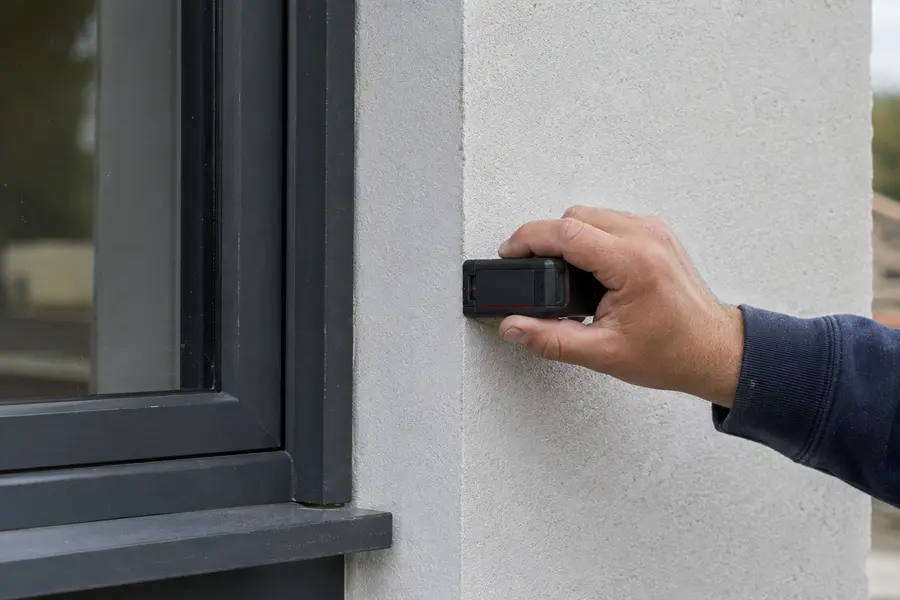
A draught you feel near the window is usually coming from the joint between the frame and the wall rather than through the window itself. Perished mastic around the outside is the usual culprit and is cheap to put right.
If the draught is coming through the closed sash, the seals or the hardware have gone. Both are replaceable on a frame worth keeping.
There is a simple test. On a windy day, run the back of your hand slowly around the closed sash, then around the outside edge of the frame where it meets the wall. If you feel it at the sash, it is seals or hardware. If you feel it at the wall, it is the perimeter, and no new window will fix a perimeter that gets sealed as carelessly as the last one.
Cold radiating off the glass is not a draught, though it feels like one. That is the pane being cold rather than air moving, and it points at the glazing unit rather than at any gap.
Rot at the Sill
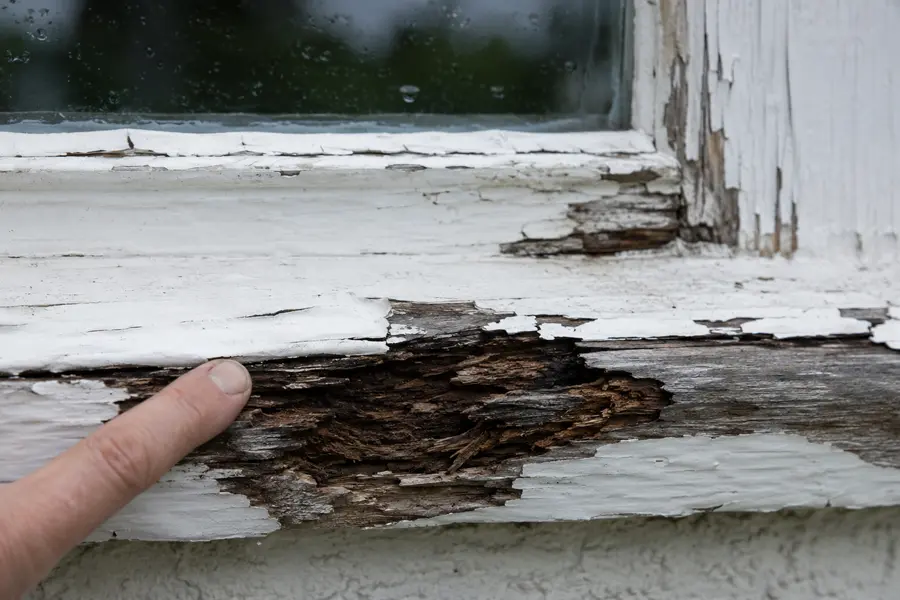
Press the timber sill with your thumb. If it gives, the rot is established and a repair is a delay rather than a fix. This is the most common reason older Irish windows finally get replaced.
Check the bottom corners of the frame as well as the middle of the sill, because water collects and sits at the joints. Flaking paint on its own is cosmetic. Paint that lifts and takes soft timber with it is not.
Rot is a symptom rather than the disease. Something is holding water against that timber: a sill without a proper drip, render bridging the joint, a blocked gutter above, or a failed seal letting water track behind. Replacing the window without fixing the cause buys you a new frame that will fail the same way.
How fast this progresses depends on where you live. In Cork, where high rainfall and long damp spells are the norm rather than extreme wind, rot and mould at the reveals are the failure most contractors meet. In Leitrim the same persistent damp works away for years without a storm ever being involved.
Mould in the Reveal
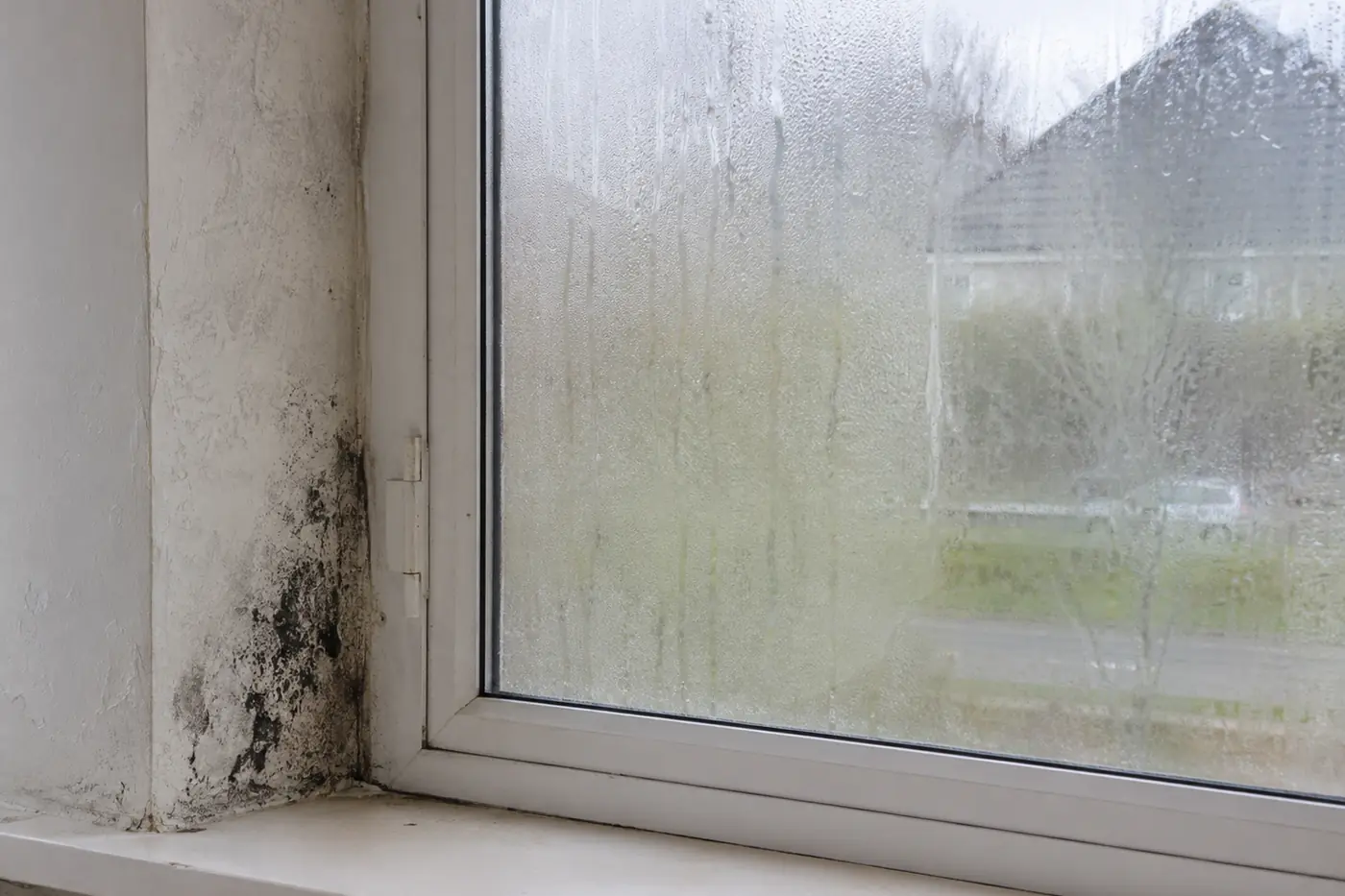
Black mould in the corner of a reveal is a moisture problem meeting a cold surface, and it usually says more about the wall and the ventilation than about the window.
A cold bridge at the reveal, where the wall construction lets heat straight through beside the frame, produces a cold strip exactly where the mould appears. Replacing the glazing without insulating that reveal leaves the cold strip in place.
Ventilation is the other half. If the trickle vents are blocked or painted shut, or there are none, the moisture generated by ordinary living has nowhere to go and settles on the coldest surface it can find.
Tell the contractor at the survey if a particular room suffers. It changes what should be specified at the reveal, and it is far cheaper to address while the wall is open than afterward.
A Sash That Will Not Close Properly
A window that has dropped is usually a hinge problem, and hinges are cheap. If it has dropped because the frame itself has twisted or the corners have opened, that is a replacement.
A fitter can tell the difference in about a minute. It is worth the call before assuming the worst.
On the coast, hardware is generally the first thing to go and the frame is often still sound. Salt in the air corrodes hinges, handles and locking mechanisms years ahead of schedule, which is why houses in Clare, Sligo and Kerry frequently need ironmongery long before they need frames. Replacing a whole house of windows because the handles have seized is an expensive way to solve a cheap problem.
Stiffness is worth acting on early. A multipoint lock that is getting harder to throw is usually telling you the sash has moved slightly, and adjusting a hinge now is far cheaper than replacing a mechanism that has been forced for two years.
Repair or Replace: How to Decide
The honest test is whether the frame is sound, square and worth keeping. If it is, almost everything else is a repair.
Repairs worth doing: swapping a failed sealed unit, replacing hinges, handles or a locking mechanism, renewing perished seals, and re-sealing a perished perimeter. All of them are small money against a full replacement.
Replacement is the answer when the frame itself has failed. Soft timber at the sill or the corners, a uPVC frame whose welded corners have opened, a frame that has twisted so the sash no longer meets it evenly, or a profile so old that hardware for it is no longer made.
The other legitimate reason is that you are doing the whole house anyway. Doing more windows in one visit may reduce the cost per window, so if most of the openings are near the end, ask for quotes for doing the sound ones at the same time.
If you are not sure which of these you have, that is a survey question rather than a guessing exercise. Somebody registered in your own county will tell you in a few minutes whether you are looking at a hinge or a house.
A Walk Round Worth Doing Before You Ring Anyone
Twenty minutes with a notebook will tell you most of what a contractor is going to tell you, and it means the conversation starts from facts rather than from a sales pitch.
Start outside. Walk the whole house and look at the joint where each frame meets the wall. Perished mastic, cracked render at the corners, a sill without a clear drip underneath, or render bridging straight onto the frame are all worth noting, because they are the places water gets in.
Look up while you are out there. A blocked gutter or a leaking downpipe above a window will rot a sill regardless of how good the window is, and fixing that is a different and much cheaper trade.
Then go inside and do one room at a time. Open and close every sash. Note which ones need forcing, which ones have dropped so the handle no longer lines up, and which ones rattle when closed. Check the corners of each pane for misting between the glass and the corners of each reveal for mould.
Write down the count as you go: how many openings, how many of them open, and which type each one is. That single list is what a contractor needs to price anything, and having it ready shortens every conversation you are about to have.
Mark which elevation each problem is on. A pattern almost always appears, and it is usually the wall facing the prevailing weather. In Galway or Sligo that will be the west, and it is why phasing a job by elevation makes more sense than doing it by room.